Saturday, May 25, 2013

Warrumbungle National Park - Grand High Tops Walk - Road trip with Danish visitors - Part 6


The Grand High Tops Walk is one of the best walks I have done in Australia! It is mentioned in my good old "Walking in Australia - 60 Great Walks" book. The beauty of the Warrumbungle National Park is that it has it all, including some spectacular vistas. Alfred J. Pincham donated some very pretty country side - probably not the worlds best farmland, but pretty indeed.
Once again I will have to excuse the ridiculously large delay between when I actually experienced the events described in my blog post and when I managed to get it online. Our Warrumbungle trip was from before the terrible fires that ravaged Warrumbungle National park earlier in the year. Hopefully, the flora and fauna in the park will once again show its resilience towards fires and manage to spring back to glory much faster than what anyone expect.
 
Great views and the iconic rock formation known as "The Breadknife" located approximately a third of the way into the walk, easily justify the uphill struggle you have to endure during the first part of the walk. The "razor" thin vertical rock formation is pretty special indeed.


Having been amazed by standing at the base of the breadknife itself, it only gets better when continuing the walk. As you wind your way up the mountain, you get increasingly impressive views, of the breadknife in particular.

Halfway through the tour it is mandatory to sit for a while "on top of the world" and just be amazed by the spectacular volcanic landscapes surrounding you. Ancient old volcanic "cores" have been left standing while the landscape around them have eroded away. Creating a varied rough green landscape with huge bare brown-black domes scattered around breaking all the greenness. Fantastic views - That day, sitting there in Warrumbungle looking at all that prettiness, was the day I decided to invest in a wider lens, 50 mm did just not cut it! - I know, I can stitch photos together, but there is something special in being able to catch it all in one go.

There was good wildlife along the way. In the forest part in the beginning of the walk was a good selection of birds, nothing breathtakingly exciting, but nice to have some winged companions around during the walk.
Warrumbungle National Park is a well visited park and the walking tracks are constantly busy, hence birds are very familiar with us humans roaming around in their habitat. This allowed me to get fairly close to a number of birds and get some decent close-ups. Like for the Double-barred Finch and Red-Browed Finch below: In the rockier upper part of the walk we very treated with numerous sightings of White's Skink, Egernia Whitii. Wikipedia mention that "It is highly variable", which the three photos below will support, note that color is by all means a poor identification method for this skink, but the spots is the give away.
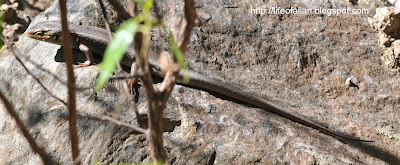
Also a Copper-tailed Skink, Ctenotus taeniolatus, was out to enjoy the heat and despite of not seeing any new birds and the sad lack of a snake sighting, we could have hoped for no more.

All in all a fantastic road trip with my Danish visitors! Gundabooka National Park and Warrumbungle National Park is a great combination for a display of some Australian nature. One being dry, red and dusty and the other sporting green forest, old brown volcanoes and fantastic walks - as mentioned above Warrumbungle burned earlier in the year, but I am sure it will soon be worth visiting again.

Sunday, January 6, 2013

Warrumbungle National Park - Road trip with Danish visitors - Part 5

Warrumbungle National Park is one of those places that just feels really right from when you first enter the park. Great nature, some of the most spectacular views NSW has to offer, a good selection of wildlife and lovely campsites - all in all an excellent place for a long weekend. The only negative thing I can say about Warrumbungle National Park, is that as a bird habitat it is not different enough from areas much closer to Sydney to support more rare and "exotic" bird species. My Danish visitors were, however, not too concerned about the lack of ticking possibilities and frankly, I enjoyed being able to concentrate on doing some good bushwalking rather than having to stand and examine any scrub or bush that had managed to produce a chirp - lovely to know that there was no chance of the LBB (little brown bird) that had produced the sound would be new on my list. The creature that can get those fresh of the plane Danes fired up is the kangaroo! After nearly six years in Australia, I had forgotten how strangely different these jumping marsupials are compared with the fauna at home. Maybe as a consequence of the new found attention on their behavior, we managed to experience something I have only seen very briefly before, kangaroos fighting each other. Two younger males from a little group of kangaroos were on their back legs circling each other while punching with their front legs and once and a while trying to land a kick from those powerful hind legs.
At first it seemed much like a part of a game, but as it continued it was pretty clear that it was not just for fun and that "the game" would continue till a winner was found. White-winged Choughs greeted us when we returned to the campsite - indeed they greeted us wherever we walked - warning everyone about our arrival. The Leaf-curling Spider below is always a good photo opportunity. Its ingenious way of recycling leaf litter allows it to sit protected while keeping watch over its web. Many other spiders do not dare to be actively hunting during the day, since the roles can easily change and they would become the hunted. Notice how the leaf-curling spider sits with a few of its legs gently placed onto the web, ready to strike as soon as it registers vibrations caused by caught prey. The drive from Gundabooka to Warrumbungle had taken quite a bit of the day and we decided to have an early night, the following day we would do the Grand High Tops circuit, which is best done well rested. We had arrived late at the campsite and had had some difficulty in finding good flat areas for our tents - at least flat areas in safe distance from known snorers. I had, after quite some time, found a great spot away from other tents and had happily pitched my tent. Crawling into my tent that night, my head torch pointed straight down into the ground and I noticed a few circular holes with shiny reflections in them .. I had apparently camped in the middle of a spider colony! I was unlikely to find a better spot for my tent in the darkness and the action packed dirt just outside my tent gave a fantastic opportunity for playing around with my macro lens (the Sigma 150mm f/2.8) trying to get focus (and flash) on the spider sitting approximately 5 to 10 centimeters deep in its burrow .. It took quite a few attempts before I got the one above.

Sunday, August 5, 2012

Gundabooka National Park - Mulgowan Aboriginal Site - Road trip with Danish visitors - Part 4

Back at Dry Tank campground after an eventful day, it was pretty clear that we were all up for a less stressful afternoon. Outback summer hiking is pretty demanding and we all had that good honest feeling of having had a bit of a workout. After spending a few hours leaned back in a camping chair only managing to get a photo of a curious Common Bronzewing and discussing the fine art of managing your water ration while hiking - should you drink it all in the beginning to save weight up the hill or is there a hint of sense in keeping a few milliliters for the last three hours of the walk? - Both tactics had been tested that morning with various success! :-) Finally, we were ready to explore a little again and took the car to Mulgowan Aboriginal Site, close to the entrance of Gundabooka national park. Water is life in the outback and if there is water there will be signs of life. Mulgowan is such a site, walking along the path you only slowly realize that you are brought into a very shallow gorge. Water has over time carved a strip through the rock and left a little oasis, where plants, animals and humans have been able to find shadow, shelter and reliable drinking water. It is in no way an impressive majestic gorge, but considering the dry sandy landscape surrounding it, you understand the importance of the place. The caves bordering the gorge display a good selection of Aboriginal rock art and we saw significantly more wildlife surrounding the site, than we had seen hiking across the dry plains during the scorching midday sun .. those kangaroos seems to understand water ration managing and Australian weather much better than a gang of Danish tourists! Bird life was not as good as I had hoped for. The most likely reason is that a wetter Australia allow the birds a much wider selection of places to drink, therefore they are not forced to all journey to those secure waterholes that so many birders take advantage of at sunrise and sunset in the dry outback. Abundance of water allows life to flourish and spread, but strangely enough it also makes it harder to see those hard to find species at their usual secure habitats. After a good solid day we could all sleep. Early next morning I took the macro lens for a little trip to the bush toilet. The humidity generated in those bush dunnys attracts an excellent selection of exciting creatures, and this morning was not different. Highlight was the close-up of the Mantis above. After a few days of outback loveliness the part of our little party that had the joy of sharing a tent were quite adamant that any change of a close encounter with some water and a bathroom without Mantises would be appreciated. Having seen some red dust it was time to see what else NSW had to offer and I decided, that Warrumbungle National Park was just the right place to setup camp for the remaining part of our journey.

Sunday, July 15, 2012

Gundabooka National Park - Road Trip with Danish Visitors - Part 3

Summit day! Not too bad using a day off climbing an outback mountain. I had done it before and I can promise that I would love to do it again. After a great nights sleep we got up, had some porridge, filled the water bottles and the fresh-of-the-plane Danes had to use some time getting their virgin skin covered in a protective layer of sunscreen. While all that rubbing was going on, I gave a little 101 on how to walk in the bush, what species of animals we were likely to encounter and that we would not see. I used quite a bit of energy explaining that we would not(!) encounter snakes and therefore we very perfectly safe walking through high grass and scrubby bush. I think, I even managed to state that seeing a snake under these conditions would be as lucky as winner the big one in Lotto .. after approximately 100 meters of walking the little fella below tried to cross the path in front of us. According to my previous statement it could obviously not be a snake - that would be too lucky - so I mentioned that there was a good chance of it being a legless lizard ... having had a bit of time looking at photos and a visit to the the website for the Atlas of NSW Wildlife, I must admit that Gundabooka is inhabited by two types of snakes with black heads, the Monk Snake and the Mallee Black-headed snake, my best guess is that our little friend is a juvenile of the latter. Crossing the scrubby flats is warm and tedious work, but the reward is well worth it, as soon as the landscape start rising the bushes and trees disappear and you start climbing Mount Gundabooka. There is no well defined path to follow and if you get to eager and try to gain high too fast, you are likely to be find yourself stuck in a dead end having to backtrack, but as long as you take it easy and just follow the flow of the landscape it is an easy climb. Taking your time on the way up gives you the possibility of observing how plants, insects and animals change as you leave the grassland below and get some rock under food. The views change as well! What a lovely way to spend time with some good friends! Sitting on a big rock in the middle of nothing, with wood swallows circling around you, skinks curiously peaking out from their small caves and a wedge-tailed eagle hovering high above trying to spot dinner or just out stretching its wings. The raw landscape of Gundabooka national park and the views from the mountain makes it one of my absolute favorite national parks in Australia. If you live in Sydney and have visitors flying in, that are willing to (and capable of) doing a good hike/climb, I think Gundabooka is their best chance of getting a feel of what the Australian outback is about .. unless you splash out and fly.