Showing posts with label wildflowers. Show all posts

Thursday, June 2, 2011

Royal National Park


Things have been incredible busy around here during the last few months and once again I have have had a hard time balancing the act of getting out there exploring and the task of getting it all written down and documented. Hopefully this blog post will be the first of a quick series of postings that will bring me nearly up to date ;-) One can only hope.

Some time back I did a few walks with the Amoores in the Royal National Park, here is a little sum up of the highlights. The Australian summer do not invite for big excursions into the wilderness – you simply cannot carry the water needed for big walks, and relying on picking water up along the way is risky business – those small creeks have a nasty tendency of going dry when exposed to hot Australian summer weather.


A national park pass is a great idea, particular if you are doing short one day trips out of Sydney, since all of the parks around the metropolitan area is covered by the little sticker – in particular The Royal National Park down south of Sydney, aka “The Royal”.

The coastal national parks close to Sydney all delivers a great combination of the raw power of the sea mixed with spectacular sandstone cliffs, windblown heath and pockets of bushland. The mix in landscape ensures suitable habitats for a broad variety of wildlife. The Royal National Park is the biggest and arguably the most impressive of them all - not much beats a wander along the roaring sea, seeing how the waves pounds the sandstone cliffs, while White-bellied Sea-Eagles soars above :-)

These trips to the Royal National Park were indeed more for the joy of getting out rather than us targeting specific birds or other wildlife and as always, when you get out of your hobbit hole things starts happening around you and it is not necessarily what you expected to find.

The coastal heath delivered the usual gang of birds. You seriously have to admire how the New Holland Honeyeaters have conquered every single stretch of scrubby coastal heath on the NSW east coast, so much indeed that I have finally stopped taking those NHH photo, where a daring individual sits high, exposed above the scrub, taking looks at those camera slinging travelers passing through his windblown habitat. Instead I concentrated on the fantastic explosion of color, that was added to the otherwise dull scrubby green heath by a larger than normal presence of wildflowers.

I have tried to avoid it for years when it comes to wildflowers, but as with the birds and the other stuff I take photos of it all becomes more interesting when you start naming it. Pretty photos are all good, but if you can add names, then you also get the stories and the insight. So here we go, with great help from the all knowing internet I am willing to risk it and name the wonderfully red and white colored beauty above as Native Fuschia or Fuschia Heath, Epacris longiflora. Easy - even with next to no Latin skills it makes sense to name these elongated flowers "longiflora" i.e. long flowers.
The Rush Fringe Lily, Thysanotus juncifolius, below was actually the reason why I started looking for wildflower names - it is a stunningly beautiful flower and I simply felt that I needed to put the effort in to at least name this little gem. Next time I promise that I will bring the macro lens for some more appropriate close ups. The flower only last one day, but there are probably a couple of neighbors slightly out of sync, if you need more than 24 hours to return.


The strange looking "flower" below is from the Drumsticks & Conesticks family, Proteaceae. Spending some time online I have reached the conclusion that this one is the Narrow-leaf Drumsticks, Isopogon anethifolius.


A tip from a guide book steered us up along a little fresh water creek, through some scrubby bush and suddenly we were at our own private little waterhole, with waterfall, shade and some very confident and photogenic Water Dragons, Physignathus lesueurii.


The level of confidence should be pretty clear from the photo below - if food is on the other side and the way has been blocked by a shoe I will just have to climb the shoe .. and the fact that the shoe was well and truly attached to the leg of a human, that did not try to sit particular still, was of less concern :-) Not even the pregnant member of our little bushwalking gang showed that much lust for food.

A final treat, was the spotting of yet another wildlife species lured in by the power of food. While sitting eating on the sloping rocks bordering the waterhole tiny amounts of food must have dropped into the water, because suddenly a crayfish, Euastacus, emerged from the deep, searching for a meal. It was so eager indeed that strategic placement of crumbs in hard to reach places, nearly lured it out of the water.

Great stuff, once again the Royal delivered! These trips are very much a testimony to the fact that if you get out, you might not always see what you expect, but you will see something exciting.

Friday, March 5, 2010

Mount Kosciuszko - Summit day!


Conquering Mount Kasciuszko, the highest pinnacle of mainland Australia, on Australia day! How much more Australian can it get? :-) As mentioned in the previous post we set out on our endeavor very early in the morning, to be able to make it back to Sydney before night fall. In reality we had heaps of time, since the climb is indeed quite gentle and can be done easily as a half day walk.


Crossing the Snowy river once again, we took the time to examine the crystal clear water and managed to spot a bit of underwater wildlife. The fishes of the alpine region of Kosciuszko have a very interesting story. Being a fish high up on a mountain does obviously have its difficulties, since water, as I am sure you readers are aware of, runs down when given a chance. So as a fish you either have to use enormous amounts of energy "staying high" or find steady water - like Blue Lake - and stay there at the cost of isolating yourself in a restricted area.

Indeed Blue Lake holds an endemic subspecies of the Galaxias family, obviously in close family to the small Galaxias sp. of the snowy river - like the one in the picture above - it has been isolated long enough to become a species of its own. In fact, if you "dive" into the literature you realize that the parting of water in the Kosciuszko National Park has lead to a number of fish subspecies each filling their own little niche of habitat. Exciting stuff!

With all that excitement going on around us it took a while to make it to the summit, but we finally found ourselves at the target of our walk, 2228m above sea level, Mount Kosciuszko! When coming from Charlotte Pass the "peak" looks quite flat and boring, but standing on the top you have some very impressive views.

Walking in the Kosciuszko National Park during Australian summer is absolutely fantastic, nowhere else in Australia (except maybe for Tasmania) can you do some serious hiking this time of year without having to bring your own body-weight in drinking water. The morning walk to the top had near perfect temperature and standing admiring the views was nearly a bit chill - very nice indeed!

Realizing that the ascent had taken slightly longer than expected we cranked up the speed a bit and pushed rapidly down the mountain. Guess we were all ready to get back to Sydney, there is something about coming home that is nearly as good as being on the move .. and I was super excited about getting the pictures onto the computer.

Again it was astonishing seeing the variation and quantity of the wildflowers along the path, during the ascent you noticed how a type of plants start being more common and then slowly disappears again as you go higher, each species having its own optimum micro habitat.


I really would have liked not having to name those grasshoppers, but since they are here on the blog I should at least give a qualified(?) guess. The one above gave me a hard time and only after realizing that the red dots are not a part of the grasshoppers natural coloration it started working out. After looking into a bit of grasshopper literature I found a Monistria sp. that looked quite similar and then it did not take long to find the Spotted Mountain Grasshopper Monistria concinna .. It should have been easy; it is spotted and we saw it while bushwalking in the mountains! :-) Best guess for the grasshopper in the picture below is probably an Yellow winged locust Gastrimargus musicus, you may argue that the wings are not yellow (I can reveal that I had the same thought), but apparently they are when unfolded! - see here :-) .. however, as always any suggestions are very welcome.

Monday, March 1, 2010

Kosciuszko National Park - A "Closer" Look At Day One


After the fantastic, but bird-less, days in Ben boyd National Park I can nearly feel how my readers are lusting for a few good bird stories :-D I have to be honest straight away and say that the alpine part of Kosciuszko National Park delivered exceptionally few birds, of which most where Australian Pipets. However, when you go to a habitat so dramatically different you are going to see new and exciting stuff and we had unknowingly picked the absolutely perfect time of year for a magnificent display of wildflowers galore!

Overlooking the landscape you straight away know that a place like that is not going to sustain much wildlife. Nowhere to hide and nothing eat! It is not entirely true, the alpine region is home to a few types of birds and one type of marsupial, the critically endangered Mountain Pygmy-possum, however, it sleeps 7 months a year :-) The lack of larger wildlife means that smaller creatures can roam - and hence a fantastic symbiosis between insects and wildflowers can blossom!

First time ever during day light hours I actually realized that the 150mm macro was the choice of the day rather than logging around the Bigma. There were simply too much exciting small stuff that needed to be digitalized and little G. was handling the point and shoot just fine, producing most of the landscape shots you saw in the previous blog post.

Once again, I have to admit that I do not have the appropriate knowledge or literature to give a thorough and convincing description of what species we actually managed to see. However, with some help from the internet in combination with a bit of guessing I should be able to name at least a few of the flowers in this blog post. Starting out, I am quite confident in naming the large orange pom-pom in the first picture as a Billy Button or Craspedia.

The orchid in picture three looks very much like one of the Leek Orchids, Prasophyllum sp., after a bit of searching around trying to determine more accurately which one, I realized that apparently there are 126 species so I will leave that task till later ;-) .. Actually just as I had given up after looking at all the well-known(?) Prasophyllums I found the best fit so far: Mauve Leek-Orchid, Prasophyllum alpestre - still all suggestions are welcome.

The strange looking flower below seems to fit the description of a bidgee widgee Acaena novae-zelandiae. According to a comment I found on the internet, this flower is quite famous in Australia (guess that must be in the flower community?) as the first weed Australia managed to export to the rest of the world - pay back time!! :-D

The Royal Bluebells in the picture below is indeed the flower chosen for the Floral Emblem of the Australian Capital Territory (ACT). There you go! :-)

All this flower stuff is quite interesting if you have a bit of time to kill and the internet is a fantastic resource. While searching around I found this google book, which at least title wise seems to be spot on. Probably a task I will leave to later as well, but please let me know if it is good. :-)

Saturday, February 27, 2010

Ben Boyd National Park - Saltwater Creek, Boyd's Tower And A Bit Of Evening Adventure


Snakes are probably some of the most interesting animals you can stumble upon down under here in Australia! Interesting is exactly the right word, it has nothing to do with if you "like" or "hate" snakes, I probably used to be slightly on the scared side when it came to imagining how an encounter would be, but the more you read about these highly developed animals the more impressive and interesting they are - with a healthy understanding of the need to observe from a distance. On our way towards Boyd's tower in the northern end of the south part of the park this Tiger Snake was crossing the road just in front of the Magna. Rapidly blocking the breaks and having the Nikon handy gave just enough time to catch a few snapshots of this shy impressive creature.

Benjamin Boyd went through enormous amount of trouble to build his 20 meter tall tower. Initially the plan was to use it as a lighthouse, but as with Benjamin's own story the tower has had a colorful past.

The area around the tower looked promising; scrubby coastal heath with good possibilities of over viewing large areas and some patches with dense taller scrubby trees giving excellent opportunities for birds to hide .. in fact they were hiding(?) so well that we saw next to no feathered wildlife while walking around in the area surrounding Boyd's tower.

It was getting late and with a thick layer of clouds coming in, light was getting worse and our chances of spotting and documenting (by getting pictures) any rare bird where disappearing fast.

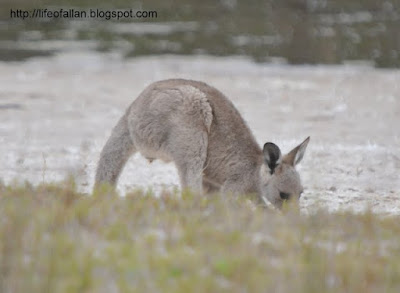
We decided to cover the entirety of the park by visiting Saltwater Creek Campsite and see if we would be lucky and spot a few of the specialties of the park, such as, Hooded Plover or maybe even a Ground Parrot on the heath area just south of the campsite. It was a great walk, we saw a White-bellied Sea-eagle cruising along the coast, but no sign of a tick :-) Managed to find a few wild orchids though and a good old fashion kangaroo grassing on the beach.

What a great day! Full speed all day and we had managed to cover nearly all parts of the national park. Sitting at the campsite I have now learned that when it goes slightly dark it is time to take the light hungry Bigma off the camera and take advantage of the built-in flash and the light collecting properties of the macro.

As the very last light of the day disappeared a last chance of a tick emerged on the sky; Swifts! Pulled a few photos with the macro and will have to go through them more carefully one day, but it mostly looked like White-throated Needletails .. great bird, but not a tick.

Ben Boyd National Park had a final little treat in place for us. When we arrived at the campsite, the people leaving the spot we had reserved for the weekend had pointed out that we should be careful with leaving food around since a gang of possums roaming the area opportunistically associated the presence of humans with presence of food, apparently they had lost any fright of humans.

The little fellow above was jostling through our camp looking for any leftovers not even noticing that we where still standing around chatting and brushing our teethes. Little G. decided to hide some fruit in the tent for breakfast instead of carrying it all back to the car. Amazingly what we believe to be a possum could smell the goodies on the other side of the thin tent wall and decided to try to eat an apple through the tent wall :-D

Ben Boyd National Park is a great spot! We saw heaps of exciting stuff; snakes, orchids, possums and bats flying around the campsite, super duper spot with some fantastic camping next to a great little beach. We tried some snorkeling which was slightly disappointing, but hey how much can you expect from one place? ;-) Leaving early Monday morning we were heading for something very different; Kosciuszko National Park.

Friday, September 25, 2009

A Long Day in Botany Bay NP - Part 3 - Insects and Wildflowers


My first insect in flight (IIF) photo :-) This little fly had a very curious behavior, it was flying about 10-20cm above the ground in a very intermittent way. Standing absolutely still examining the ground for about 2-4 seconds and then performing a quick move to a new spot reengaging into the surveillance mode. I do not know what it was searching for, but considering the massive (compared to body size) spear like protrusion, I just know that I would not like to be the target of its attention.

I cannot help getting sucked into macro photography! Still contemplating on how much return I can expect from an investment in some macro glass. Will it end up on the shelf, with me continuing shooting pseudo-macro with the Bigma or will I actually carry another (couple of) kilo(s) of glass around and use most of the time changing between lenses? :-)


Bull ants are very impressive fighters! Putting 3 kilo of camera equipment near them and they will stand on their back legs frantically trying to attack the intruder - put xx kg of Danish farm boy and they will in similar fashion do anything possible to spur an encounter.

If you know your bull ants well, you will actually be able to determine where you are from variation in the coloration of the bull ant chewing on your leg. They can be anywhere from all red to all black and as large as 40mm, in common though; they all have a nasty bite ;-)