Showing posts with label Kosciuszko National Park. Show all posts

Saturday, March 6, 2010

Ben Boyd and Kosciuzko NP Long Weekend Road Trip Coming to An End


There you go! No more blog posts about Ben Boyd or Kosciuszko National Parks for a while at least. Fantastic road trip! Amazing how much of Australia you can cover over a long (4 days) weekend and equally amazing how fast the landscape changes when traveling. From the scrubby coastal heath, through dense dark rain forest to treeless alpine regions in a day!

We saw next to no new birds, but we saw so much other stuff that it is hard to be disappointed. It totally makes sense visiting either one of the southern coastal parks or a "cold" alpine park during Australian summer. The fact that both of the parks are located only a "short" half day drive from Sydney makes the trip we did very doable in 4 days and we did not have the feeling of having to drive all the time. Choosing only one of the parks it should indeed be possible to do in a normal weekend.

As usual I have made a Picasa album with the best pictures from the trip, some have already been used in the blog post, but there are a few more you can access by following the link below. This holiday was the first time I really started using my new macro lens and it was super exciting shooting with such a type of lens. I am amazed how versatile it is. Obviously it shines doing macro photography, but the night shooting capabilities and the fact that I more or less could use it as a walk-around lens were pleasant surprises.
Macro photography is not expensive at all! An old manual focus lens will be fine, set the lens to 1:1 i.e. its closest focusing distance and obtain focus by leaning forward and backwards. Most macro lenses are super sharp and even if you are a fanboy that gets shivers when thinking of putting a 3rd party lens on your camera, I can calm you down by telling that I have seen old manual micro (that is macro in Nikon language) Nikkor lenses selling at less than $25 on ebay.
Kosciuszko National Park

Friday, March 5, 2010

Night In Kosciuszko National Park


As soon as darkness fell, the possums and gliders were on the move, fantastic stuff! Once again we had a possums walking straight through our camp and a glider sitting in one of the campsite trees less than 10 meters from our tents.

It is a glider in the forth picture, diagnostic features are the skin fold up around the front legs and (apparently) the white tip of the tail. The excess skin is what allow these nocturnal creatures to avoid having to walk on the ground during night, but instead fly -or glide - between trees by transforming themselves into a flat, thin and lightweight wing.

One of the reasons for buying a longer macro lens i.e. 150mm was that it would double as a fast semi-long lens that could relieve the bigma under difficult lighting conditions, where light gathering properties become more important than reach; such as in a dark rain forest or while doing night spotlighting in the Kosciuszko!

A fast lens, like the f/2.8 macro, needs much less light to autofocus simply because it allows more light to flow through the lens, giving the autofocus module more contrast to work with. Together with the D300's excellent auto focus capabilities and build in flash it means that you (with a bit of luck) and help from a skilled spotlighting team mate can get auto focus on the various nocturnal critters even during the darkest dark of nights and get usable pictures.

The nocturnal mammals are obviously great targets for some night photography, indeed they are not as rare as one would think, they simply hide really well during daylight hours when us humans are more likely to walk around in their habitat. However, I might actually prefer all the crawly stuff that comes out when it gets dark. The weirdest bugs and spiders are everywhere if you look for it and as subjects they show quite a bit more patience with the slowness of your photographic skills - it simply takes them longer to run away.

Great stuff and we could happily go to bed dreaming about bugs and spiders - not bad at all :-D At about 3.30am we were woken by what we probably all had secretly hoped would happen; the call of a nearby owl! Poking little G. was at first not very successful, but after a few pokes contact was established and risk-benefit negotiations were initiated: Risk - we have seen it before or it would fly away before we got out. Benefit - seeing an owl, what more can you hope for?

In the midst of all this we suddenly heard the sound of a tent door zip being opened and we knew that the hunt was on! First guess was that the owl-spotting-machine Adelle had convinced Jarrod to get his lazy arse out of bed to join for some spotlighting, so we were a bit surprised to find Jarrod alone - Adelle's long proven success with owls had probably made her estimate that it was very unlikely she would gain a new tick and hence she had valued sleep higher than a nightly excursion into the dark :-D We got great views and pictures of a large Tawny Frogmouth probably sitting wondering why people were running around below it. In the end it had had enough of all the shenanigans and flew off and we could get back into bed.

An early start to the day proved that early mornings can be as good as late evenings, when it comes to spotting exciting wildlife. The Pseudoscorpion above was a very surprising early morning visitor, I have never seen the kind before. Despite its dramatic looks and venomous pincers it is not dangerous to humans - good to know! Guess the pseudo- part of the name comes from the fact that it misses the stinging tail that you normally associate with proper scorpions. As you might have noticed I have linked quite heavily to the lifeunseen.com web-page in these Kosciuszko blog posts. I am very impressed with the quality of the site and the fact that it combines great pictures with heaps of information about the insects - good work!

The spider below had taken full advantage of the human presence at the campsite and made its fantastic web inside the toilet block, probably taking advantage of insects being attracted by the higher humidity. It is obviously from the master weaver group, I have tried including the outline of the circular web - notice the two thicker "spokes" used to enhance the strength of the web. The spokes system does apparently go under the name stabilamentum and can vary from quite simple, like in my picture, to creation of art! See more examples here.

All good stuff! However, we had to get going, this 2010 Australia day was going to be a busy one, not only did we have to make our way back to Sydney, but we had planned to conquer the highest peak of the continent before leaving - Mount Kosciuszko - Summit day! ;-)

Thursday, March 4, 2010

Kosciuszko National Park - Camping at Sawpit Creek


We are getting soft - really soft! The choice of campsite was a victory for an abundance of luxury. Instead of the good old pit toilet, we ended up with proper ones, add to that hot water, even hot showers and to make it almost ridiculous, we ended up having access to washing machines! :-D So needless to say that the Sawpit Creek campsite was a huge success.

After a long day of driving followed by some hard walking - and it was really quite hard lugging 4kg of camera equipment around in the alpine countryside - we could probably all need a bit of feeling clean. The campsite was indeed quite fantastic, while the day was slowly coming to an end, things started happening around us. A couple of residing kangaroos came in close to investigate what dinner plans we had and a couple of fast moving Treecreapers had us fired up, however, the flash of red came from a spot behind the eye - not above! Making them juvenile White-throated TCs .. i.e. I still miss the Red-browed Treecreaper.

I think, I have always been quite alert to the various types of insects around down here in Australia - as a tourist arriving you often are, since you have heard all the stories about deadly spiders and other nasty critters. But that alertness has probably been pumped just a notch by investing in a macro lens. Extra alertness or not, I do not think I have ever seen as many interesting bugs crawling around in our vicinity and that was even before it got dark!


Highlight of the bright hours was probably our little green friend below. Measuring in at somewhere around 15cm it was quite a lot of insect. It is not a Praying Mantids, since it misses the heavily spined raptorial front legs, thanks to Jarrod for pointing that out :-) I think the call was "stick insect" from the Phasmatodea group.

All good! A truckload of campsite coziness, good (spicy) dinner in the pots, excellent company and some exciting Australian wildlife, what more can you hope for? Except maybe for a seriously butt kicking world class sunset?

Those last hours before the sun goes down are some of the best time you have when camping, all the running around and seeing stuff during the day is over and you can finally allow yourself to just sit there and relax. Looking at the pictures above and below makes me want to go again! :-) This night in Kosciuszko we had planned to delay our sleep and instead use some time equipped with spotlight and camera and see what types of wildlife would be around.

To be continued ..

Monday, March 1, 2010

Kosciuszko National Park - A "Closer" Look At Day One


After the fantastic, but bird-less, days in Ben boyd National Park I can nearly feel how my readers are lusting for a few good bird stories :-D I have to be honest straight away and say that the alpine part of Kosciuszko National Park delivered exceptionally few birds, of which most where Australian Pipets. However, when you go to a habitat so dramatically different you are going to see new and exciting stuff and we had unknowingly picked the absolutely perfect time of year for a magnificent display of wildflowers galore!

Overlooking the landscape you straight away know that a place like that is not going to sustain much wildlife. Nowhere to hide and nothing eat! It is not entirely true, the alpine region is home to a few types of birds and one type of marsupial, the critically endangered Mountain Pygmy-possum, however, it sleeps 7 months a year :-) The lack of larger wildlife means that smaller creatures can roam - and hence a fantastic symbiosis between insects and wildflowers can blossom!

First time ever during day light hours I actually realized that the 150mm macro was the choice of the day rather than logging around the Bigma. There were simply too much exciting small stuff that needed to be digitalized and little G. was handling the point and shoot just fine, producing most of the landscape shots you saw in the previous blog post.

Once again, I have to admit that I do not have the appropriate knowledge or literature to give a thorough and convincing description of what species we actually managed to see. However, with some help from the internet in combination with a bit of guessing I should be able to name at least a few of the flowers in this blog post. Starting out, I am quite confident in naming the large orange pom-pom in the first picture as a Billy Button or Craspedia.

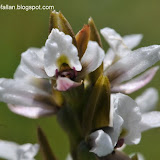
The orchid in picture three looks very much like one of the Leek Orchids, Prasophyllum sp., after a bit of searching around trying to determine more accurately which one, I realized that apparently there are 126 species so I will leave that task till later ;-) .. Actually just as I had given up after looking at all the well-known(?) Prasophyllums I found the best fit so far: Mauve Leek-Orchid, Prasophyllum alpestre - still all suggestions are welcome.

The strange looking flower below seems to fit the description of a bidgee widgee Acaena novae-zelandiae. According to a comment I found on the internet, this flower is quite famous in Australia (guess that must be in the flower community?) as the first weed Australia managed to export to the rest of the world - pay back time!! :-D

The Royal Bluebells in the picture below is indeed the flower chosen for the Floral Emblem of the Australian Capital Territory (ACT). There you go! :-)

All this flower stuff is quite interesting if you have a bit of time to kill and the internet is a fantastic resource. While searching around I found this google book, which at least title wise seems to be spot on. Probably a task I will leave to later as well, but please let me know if it is good. :-)

Saturday, February 27, 2010

Kosciuszko National Park - Going "Alpine"


What a difference a few hundred kilometers make! Leaving the coast moving inland takes you through some of the most lush, green forest in Australia. Continuing further inland the landscape goes dryer and forest turns to grassland and then you hit the mountains!

We were heading for Kosciuszko National Park, a part of Australia which I have badly neglected during the nearly 5 years I have been down here. Guess I have felt it was too similar to places I have seen in Europe and since we have no outback or rain forest around Denmark I have "focused" more on those types of habitat. However, there is something fantastic about mountains and after all the years down here it great driving up into Australia's only alpine area.

Arriving at the park around midday Monday and having to start work in Sydney Wednesday morning we were once again in for some action packed hours. As soon as we had raised the tents at the Sawpit Creek campsite we rushed back into the car and drove up the mountain, trying to put the rest of the Monday to good use and do some good quality "high" altitude hiking.

Fantastic stuff standing there above the treeline and watching how the track winds it way up the mountain - no surprises here! Just raw bare nature and that great feeling of super clean cold air. Being in the sun it is all good, but you feel the altitude as soon as there is the tiniest bit of shadow then it goes cold. The air carries very little heat.

Having arrived late we decided to go for a solid walk, but leave the summit attempt for the next morning ;-) We agreed on the Charlotte Pass to Blue Lake return walk, which had everything you can expect for a alpine walk; lots of ups and lots of downs, but no flat bits! But what a blast! :-) Walking with view of Mount Kosciuszko, crossing Snowy River few hundred meters from its source and seeing Blue Lake, some of the most unique wetland in Australia makes quite good use of a Monday afternoon.

To be continued ..