Saturday, August 21, 2010

Birding Rottnest Island


As usual, a Perth trip (nearly) always include a trip across the water out to Rottnest Island and in similar consistent fashion it never disappoint. Well to be absolutely honest, I would have been happy to finally bag a Rock Parrot, but following the usual logic it would be sad to deplete such a nice area and bring into question the need to visit it again. ;-)

I have seen Common Pheasant (top photo) in Australia before - at least 3 times - but every sighting have been brief and on Rottnest, this time I managed to get a photo which qualified for the blog. This introduced bird has, very much like the Mute Swan in Northam, only managed to establish a foothold in a few select places - all of them islands.

Another old Rottnest friend is the White-fronted Chat. Last time I managed to get a less than impressive photo of a WFT darting across the path, this time we were truly in for a treat with a little family of not less than 10 feeding at the salt lakes in the middle of the island.


The salt lakes are normally a fantastic bird spot, but this time - end of April - there was very little to see, apart from the White-fronted Chats we only managed to see a couple of other waders; Red-necked Avocet and Red-capped Plover above.

Guess there is a season for everything, no Banded Stilts at the salt lakes this time, but instead we were treated with a little Osprey family living in one of the gigantic nests placed on reefs just of the coast. Every year there are 2 to 4 Osprey families nesting around Rottnest, instead of starting from scratch they will reuse one of the up to 70 year old nest "towers" which through generations have grown to abnormal size. Those of you that know the size of an Osprey - 50 to 65cm - will be able to judge the magnitude of the construction in the photo above.


All good! Rottnest was firing on all cylinders. No new ticks, unless one of my tern-knowledgeable readers can create a bit of excitement by naming the tern in the picture below, I would not mind if someone told me that it was a Common Tern race hirundo? But if someone insist on it being a young-but-not-juvenile Antarctic Tern, then it would be very exciting! ;-) These were the bird, but I will return shortly with a underwater and probably a miscellaneous report.

Wednesday, August 11, 2010

Wungong Gorge and Bungendore Park - Place of Gum Blossom


Next and last destination of the day was Wungong Gorge and Bungendore Park just south-east of Armadale. The park supports large areas of Jarrah-Marri woodlands, including some good quality old growth which supply a varied selection of parrots with vital nesting holes.

The Jarrah trees have in an immensely impressive way adapted to the conditions of the southern end of WA. With a root system reaching down as much as 40 meters they are capably of surviving through the toughest of droughts and in the case of a devastating bush fire, the trees will be able to regrow from a underground lignotuber similar to how Mallee and Banksia survive the burning inferno. The quality of the wood has put great pressure on the Jarrah in WA, huge areas of old growth forest have been logged. Its success(?) as a building material being fueled by inbuilt termite- and rot-resistant, but application range from road fill to musical instruments.

The Jarrah and the similar but taller (and rarer) Karri are inhabitants that the tree-knowledgeable people of the region are very proud of and rightly so - get a WA tree-lover (not to be confused with tree-hugger) talking about the quality of these giants and you will be entertained for hours ;-)

Such specific habitat obviously support very specific wildlife, including some sought after Western Australian endemics - actually nearly all of the ones you can hope to find in the south! So no surprise that we found ourselves in the woods a warm warm WA day. We had taken advice from Frank O'Conner's site, it is an excellent resource for those who would like some suggestions on where to go birding in WA. His Wungong Gorge & Bungendore Park section points out that best time for a visit is early morning. Unfortunately that had not been an option for us, which we bird-wise was probably punished for. However, nothing wrong with a walk in some great forest :-)

Well you cannot really complain when you get the chance to stand and observe a group of Red-tailed Black-Cockatoo foraging the trees around you. I manged to get decent pictures of one of the females - the sex can be determined by the presence of yellow barring on the chest, the male is more deep black and has no yellow stripes. The other birds of this blog post are: Australian Ringneck, Western Wattlebird and a rubbish picture of a Varied Sittella.

I had really hoped for a Rufous Treecreaper and a Red-capped Parrot, but the good thing about dipping badly is that you have the best excuse ever for going again :-) Also, when you got the camera along, there is always something exciting around. I managed to do a bit of pseudo-macro shooting with the Bigma. The Wanderer Butterfly below always makes a good picture, by some it is considered the most beautiful insect in the world. It is another immigrant - not native to Australia, it only arrived in 1871, in north America it is called the Monarch. With those bright colorful wings it should not be a surprise that it is poisonous, it can actually be quite bad eating for even large birds. Weirdly enough it seems that a couple of true Aussie tough guys; Pied Currawong and Black-faced Cuckoo-shrike have (developed?) a stomach that can handle the poison - maybe the lesson being that if you survive years of Australian cuisine you can take on most of what mother nature throws at you :-D

Monday, August 9, 2010

Twitching Mute Swan in Northam


Well, when you find yourself standing there in the middle of Northam at the Avon River with the camera drawn and little G. running around with binoculars it is very very hard not to admit that you are actually on a proper twitch. I am not talking about a muscles uncontrollable contraction and relaxation, but rather about the journey a keen birdwatchers initiate to see a specific (rare) bird - a twitch.

That specific bird in Northam is the Mute Swan. It is the only place in Australia were you can be sure to see this species breeding in a "wild" environment. Mute (or White) Swans were brought to WA in 1896 by the British, probably to ease some severe cases of homesickness .. A Russian settler and the Major of Northam decided that Northam, with the Avon river going through would be perfect for the swans and the swans agreed - somehow the Mute Swan never really established a proper foothold anywhere in Australia and the imported animals died without giving giving life to new offspring, except for Northam where today a thriving group of ca. 80 individuals patrol the waters.


Quite funny to see a road sign giving direction to where the bird you are after resides :-D No doubt that the swans are a very popular inhabitants and that they are well looked after - in a wild way ;-)


Having once again fulfilled our goals during the very first few minuets at the location, we easily had time for a stroll along the Avon River and a walk across the suspension bridge. It is a beautiful quiet area up there ca. 100km inland and my guess is that Northam sports some seriously hot summer days. We were there end of April more specifically on ANZAC day and lets just say that it was toasty! - Sorry for being terribly behind with this blog, but I am trying!

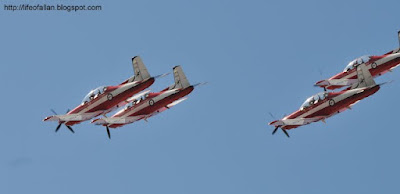
All good, I managed to catch a few flying object with the camera; some metallic ones in honor of ANZAC day and a more conventional feathered Yellow-billed Spoonbill. Half the day was gone and the next target should prove to be a lot harder - we were heading for Rufous Treecreeper habitat.

Sunday, August 8, 2010

Short-billed Black-Cockatoos in The Hills East of Perth


Short-billed (White-tailed) Black-Cockatoo aka Carnaby's Black-Cockatoo is one of the endemic birds of Western Australia. It is not as difficult to find as its very similar Long-billed cousin (aka Baudin's Black-Cockatoo) and every time I have seen them, there has been a good size flock of them. This early morning in the hills east of Perth I was particular lucky spotting in total more than 50 cockatoos foraging the tree tops in small groups, giving very little attention to the shutter pressing, big smiling Dane running around down on the ground - What a great bird!


Conditions were absolutely fantastic, cold crisp morning air and since the birds did not mind me, I was free to walk around under the trees getting the best angle for the photos. Great start to a big day.

It is a peaceful place up in the hills away from all the shenanigans of the city, so peaceful that even the birds are more relaxed. I have seen Common Bronzewing many times, but usually I find them very difficult to approach without scaring them away. The male above, however, allowed me in close - who is watching who?

I have to include a kangaroo once and a while - at least for my international readers :-D and to remind myself of how different it is down under. I have lived down here for nearly 5 years and once and a while it is good to remember some of the things that stunned you when you arrived. I can reveal that Moreton bay fig and Australian White Ibis are on the list for a fresh off the plane Dane walking the Sydney parks.


After some excellent birding I decided to change to the macro lens and take a closer look. I am quite happy with the insect in flight shot above - if just the bee had turned around! ;-)

All good, great morning - temperature had started rising and it was looking like another warm day in WA, we were heading further inland for one of the most quirky ticks around: Mute Swan in Northam.

Friday, August 6, 2010

Perth WA - Birding Herdsman Lake and Lake Monger


Back in Perth and back to Herdsman Lake - a great oasis of nature in the middle of Perth and a top top bird spot! I have always had some good luck at Herdsman Lake, during my last visit I managed to get a great shot of a Blue-billed Duck and a sighting of a Tiger Snake. This time the target was Musk Duck.

The first photo of this blog will already have reveled that the Musk Duck hunt was successful - At least for those of the readers that are familiar with this quite distinct looking duck. We literally saw the Musk Duck seconds after having stepped out of the car. The males large black lobe of skin hanging under the beak was visible all the way from the car park. I acquired focus and snapped a few, battling some harsh light and a concerned bird that quite clearly understood that it was being center of attention.


Having already accomplished our goals, we decided to transform the trip into a gently workout and set out for a stroll along the lake. Still having the camera handy, I managed to get a few shots of a couple of old friends: A couple of Australian Shelducks - the female has the white stripe at the base of the beak and a white ring around the eye, and a Laughing Turtle-dove, which is not native to Australia, but was introduced in 1898 in Perth. According to my bird book you have to make your way to WA to spot that one, but it is not on the WA endemic list .. guess a few made it across the Nullabor?


We even managed to spot a fox! Guess it should not come as a surprise with the abundance of feathered wildlife an opportunistic fox would obviously consider it an all-you-can-eat smörgåsbord.


Lake Monger is less protected than Herdsman Lake, most of the birds will be on the water and harder to get close to. It is a good walk around it and we managed to build up some appetite while getting decent looks of Pink-eared Duck, Australasian Shovelers and a feeding Yellow-billed Spoonbill.

Wednesday, July 28, 2010

Perth WA - Another Sneaky Long Weekend Escape


Back in Perth WA! The land of good walks, great nature and fantastic food :-) When first you get into the sneaky long weekend mood it is hard not to be tempted by the possibility of spending a long weekend around Perth in the western end of Australia. Only just having arrived back from far north Queensland we were off again, managing to clock up 5 days around Perth for the price of only 2 days of annual leave - that is a truly good value investment!

We took advantage of some family relations and managed to get ourselves signed up for a good solid walk. Aiming for Point Walter we were brought through some of the more picturesque parts of Perth. The fast walking and fast talking locals guides managed to tell an amazing collection of Perth stories while keeping a speed that made yours truly happy that I should just concentrate on listening. Maybe all the driving up in far north Queensland had made me lazy?

It all got very exciting at Point Walter! Despite of a high tide we decided to explore the sand spit reaching out into the river. Boots off and into the wild :-) What a great addition to the trip, being the first party to cross the water and get onto the sandy spit after the high tide, meant that we had excellent views of a good collection of WA waders and seabirds.


The bird above was a bit of excitement. First impression was that it had a shape and size similar to a Pacific Golden Plover, but nothing golden about it at all - rather grey instead. So if anyone out there can confirm that it looks like a Grey Plover, I will be very happy :-) There should be another photo in the Picasa album.


Funny how it is always the exciting bird that is shy? Black swan, Pied Oystercatcher and even Red-capped Plover were happily posing in front of the lens. Good stuff, the sand spit at Point walter is definitely worth a trip. My guess is that best time for a visit is just around high tide when the majority of the spit is isolated by the rising water.

The area along the river is in general a quite nice place! :-) You do not get the feeling of having all those other Perthians - 1,659,000 - crowding around you. Good place for watching a bit of real estate as well, unfortunately others seem to have taken an interest, so a water views will cost you $$$ ;-) Nothing beats a good walk - except maybe a good walk follow by good food. As is evident from the picture below we had nothing to complain about - a cauldron of deliciousness and we were fueled with energy for the days to come.