We could all easily have used another day or two in the national park, but even extended long weekends runs out. Before leaving the park entirely, we made a detour to the Mulgowan Aboriginal site between the Dry Tank camping ground, where we had resided, and the highway.

As always, it pays off to take you time, do some stops and detours and make the travel a part of the holiday ... hope that makes sense? On the way towards the park we had been very focused on getting there as early as possible and had tried to avoid "unnecessary" time consuming breaks. Departing already Monday morning and not having to start work before Wednesday, we felt much more relaxed about "wasting" time ... and it was tempting to try to nail the last two types of woodswallows - We had seen many thousands on the drive out (how many non-identified do you have to see to claim you have seen them all?) but a picture or two would be nice to have.

Guess it gives sense; a good spot for an Aboriginal site would obviously include accessibility to water and where there is water there is life. The eastern end of the park felt much more alive than in the dryer mulga scrub where we had camped ... in the wisdom of hindsight "Dry Tank camping ground" does not give the impression of a sparking river running close by ;-)

A short walk took us into a shallow gorge where on wet days a little creek would run through. When we were there the creek had turned into a row of small puddles, but enough water to sustain quite a bit of life. Under some of the rocks there were a good display of some heavily guarded Aboriginal drawings.

Great spot, could have been fun staying around for a bit longer, but we had decided to push a bit further north towards Bourke and do another little stop at a small wildlife refuge next to Fort Bourke Stockade.

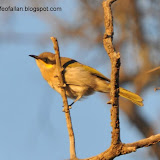
Once again it was quite evident that water means life in the outback! We stopped at a little picnic area next to the river and it was all happening around us! Absolute fantastic spot for woodswallows, but we also saw a few honeyeaters, White-browed Treecreepers, parrots, doves and more importantly a few Dusky Moorhens lacking the white tail, which meant they were indeed Black-tailed Native-hens instead :-)

All good! The hot weather sucks the energy out of you and after running around in the bush for 3 days it was actually very pleasant to enter the confined and air conditioned space of the Magna and point that long sparkling(?) bonnet towards Sydney.

Jarrod and Adelle had told us that The road between Bourke and Nyngan would be excellent for spotting reptiles and that was true indeed, we actually had a hard time trying to avoid running over various critters sitting sunning themselves on the tarmac. Apart from the reptiles the trip home also produced good views of some Blue-winged Parrots, not bad at all - one of the birds we missed last time when we did our
Mungo plus Hattah-Kulkyne trip.

Great trip, as already mentioned I saw 10 new birds, trouble is that little G. probably tripled that :-( I will desperately need to go somewhere exciting soon to get an advantage before she catches up ... and so will others ;-)
Black-tailed Native-hen
Blue-winged Parrot
Red-backed Kingfisher
Varied Sittella
Striped Honeyeater
Crimson Chat
Chestnut-breasted Quail-thrush
Crested Bellbird
White-browed Woodswallow
Black-faced Woodswallow
After 4 posts dealing with our Gundabooka trip I understand that the readers might be a bit bored hearing about the outback. For those dedicated souls that wants even more red dust and blue sky I have included a link to my Picasa album below where a few extra pictures from the trip has been included.
 Back at Dry Tank campground after an eventful day, it was pretty clear that we were all up for a less stressful afternoon. Outback summer hiking is pretty demanding and we all had that good honest feeling of having had a bit of a workout.
 After spending a few hours leaned back in a camping chair only managing to get a photo of a curious Common Bronzewing and discussing the fine art of managing your water ration while hiking - should you drink it all in the beginning to save weight up the hill or is there a hint of sense in keeping a few milliliters for the last three hours of the walk? - Both tactics had been tested that morning with various success! :-) Finally, we were ready to explore a little again and took the car to Mulgowan Aboriginal Site, close to the entrance of Gundabooka national park.
 Water is life in the outback and if there is water there will be signs of life. Mulgowan is such a site, walking along the path you only slowly realize that you are brought into a very shallow gorge. Water has over time carved a strip through the rock and left a little oasis, where plants, animals and humans have been able to find shadow, shelter and reliable drinking water. It is in no way an impressive majestic gorge, but considering the dry sandy landscape surrounding it, you understand the importance of the place.

 The caves bordering the gorge display a good selection of Aboriginal rock art and we saw significantly more wildlife surrounding the site, than we had seen hiking across the dry plains during the scorching midday sun .. those kangaroos seems to understand water ration managing and Australian weather much better than a gang of Danish tourists!

 Bird life was not as good as I had hoped for. The most likely reason is that a wetter Australia allow the birds a much wider selection of places to drink, therefore they are not forced to all journey to those secure waterholes that so many birders take advantage of at sunrise and sunset in the dry outback. Abundance of water allows life to flourish and spread, but strangely enough it also makes it harder to see those hard to find species at their usual secure habitats.

 After a good solid day we could all sleep. Early next morning I took the macro lens for a little trip to the bush toilet. The humidity generated in those bush dunnys attracts an excellent selection of exciting creatures, and this morning was not different. Highlight was the close-up of the Mantis above.
 After a few days of outback loveliness the part of our little party that had the joy of sharing a tent were quite adamant that any change of a close encounter with some water and a bathroom without Mantises would be appreciated.
 Having seen some red dust it was time to see what else NSW had to offer and I decided, that Warrumbungle National Park was just the right place to setup camp for the remaining part of our journey.