Sunday, September 12, 2010

Lamington National Park - Evening Photography From The Terrace


Being restricted to the terrace while the sun was setting behind the mountains was not to bad at all. Having all the camera gear there and good time I managed to experiment a bit.
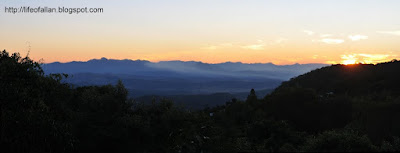
I am always impressed by the performance of the Autostitch Panrama Tool that I link to in the "Software you can't live without .. and that is free" down to the right of this site. It is really free and it just works incredible well. Set your camera to aperture priority and choose something like f/13 for landscape, see what shutter speed the camera gives you in the center of your wanted panorama. Then set the camera to manual control and dial in f/13 and the shutter speed your camera gave you before. It might sound slightly complicated, but by locking in the same exposure for all the pictures you avoid changes in brightness across the final panorama. The program works on jpg files and handles everything itself - the only thing you have to adjust is what quality you want. Choose "Edit" and "Options" and then I prefer to use the "Scale (%)" setting at either 50 or 100% - but if there are a lot of pictures being stitched and your computer is memory weak, then 25 and even 10% will do just fine.
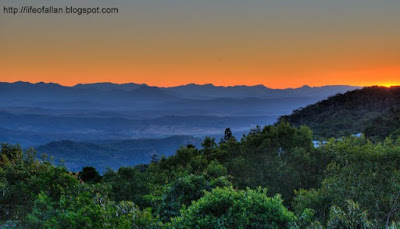
HDR is equally simple and just as exciting as making panoramas. At the moment I do not have a link to a free HDR software, I will see what can be done about that. Quite simply you take a set of photos of the same scene at different exposures (RAW images preferred). The software will then combine all the information of the photos and selectively let the photo with the most information in a certain region be the main contributor to that part of the final photo. In the photo above the most overexposed photo is probably the only one that was able to catch the details and greenness of the bush in the lower part, whereas only the most underexposed photo would have had the colors of the bright sky. It might all sound very complicated, but as for the panorama tool, it is super easy using the software and if you manage to hold the camera fairly still while shooting your photos, the software will take care of the rest.

Lamington National Park - Road Trip Into Queensland


We got an offer that we simply could not reject - a long weekend in Lamington National Park at O'Reilly's; good food, fantastic walks, great birds and exceptional company - yes, I really like my tent, the cous-cous camping dinners and even the solitude, but once and a while it is nice to be spoiled and "yes" cous-cous is great for camping, but to be honest my admiration of this tight packing carbohydrate is not so much due to its gourmet qualities - I would survive a weekend without! ;-)

Lamington National Park is located just north of the Queensland-New South Wales border. Knowing that we would have the luxury of running water et al. all of the weekend, it seemed appropriate to rough it a bit getting there - Driving the Magna is obviously always a joy, but 12 hours seems to be the point where even a good thing becomes slightly tiresome. To optimize our time up north, we left Sydney Wednesday afternoon straight after work and by bringing the tent and a bit of gear, we managing to bite the trip into two. There is a good selection of campsites close to the highway, so we pushed on until around 9pm, used about 30 min to get to a campsite and managed to clock up a healthy 8 hours of sleep before we hit the road again.

After all that driving I cannot help getting a bit jittery, luckily check-in at O'Reilly's went pretty smoothly and my companion agreed upon a quick 30 min dash into the rain forest. It was great using the legs a bit after the long drive and it did not take long before we had seen Yellow-throated Scrubwren and zoomed in on a little Logrunner family doing some excavation on the forest floor. Luckily I had brought the charger for the camera this time, because those rain forest are indeed very dark and can take a lot of flash. It was getting proper dark and we retreated to what should prove to be one of the best wildlife spotting locations of the weekend - the terrace of our rented apartment.


Pademelons in the field down below - at least until the arrival of a hungry looking dingo - bird darting around in the rain forest trees, that had conveniently been places centimeters away from the boundary of the terrace. As night fell the rest of our weekend companions arrived, just in time to see the influx of the nightly creatures of the forest - lured in by the light, an army of the most fantastic insects arrived and I was very happy, that I had brought the macro lens. The weekend had hardly started and it was already looking exceptionally exciting :-)

Thursday, September 2, 2010

Sydney Olympic Park - Above And Below The Surface


Back in Sydney and we celebrated by going for a wander in Sydney Olympic Park with the boys - keen binocular slinging long time bloggers Iain and Jarrod. What a lovely way to spend a Sunday, we managed to clock up a good amount of kilometers while spotting wildlife, snapping photos and solving most of the troubles of the world.


Sydney Olympic Park always delivers - maybe not anything breathtakingly exotic - it is still in Sydney after all :-) but a good selection of fish, birds and insects, what more can you hope for? Also, as I argued in the latest Perth post, wildlife in parks is very photogenic, if you are after good wildlife close-up photos you are better off going to a busy park than into the wild.

Good stuff! Excellent company and a great day out, back to the car at the sneaky free car park at Triangular Pond - No Lewin's Rail this time around, but only little G. needed that one, so who cares? ;-)
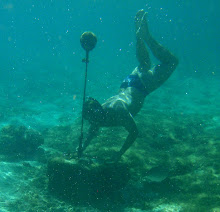
Those of you who are still wondering what creature I caught in the first photo can see a half-"full body shot" of this underwater Juggernaut patrolling the waters of Sydney Olympic Park - I will suggest using tight tight speedos if you should want to go for a swim :-D

Final Perth Post - A Farewell With A Walk And A Sunset


The sneaky long weekend escape to Perth was coming to an end, what a great holiday! Before getting airborne our fast walking hosts invited us onto another great walk along the river.

The target of our march was Tranby House, Peninsula Farm, a historic farm cottage established by the Hardey family, who had departed England and arriving in the little township of Perth 1830 to start a new life. The house was named after the ship - the Tranby - that had brought them halfway around the world. It seems the lure of water views existed even in those days or floods were more severe(?), the Hardey family had to rebuild their farm twice loosing the first two attempts to the river. The 3rd house finished in 1839 and is the one still standing there today.

Wildlife along the river included many of the expected water loving species. The constant flow of people along the river and a natural boundary between the path and the wetter habitat has over time taught the feathered inhabitants that they can safely continue doing their birding things without needing to take notice of the human shenanigans going on just few meters further ashore.

Surrounded by cyclists, runners, walkers and screaming kids I managed to get my closest close-up ever of a Egret, the photo above is taken at a puny 230mm not even using half of the zooming powers of the Bigma :-D

A welcome change to a typical Sydney walk was that the usual army of New Holland Honeyeaters were replaced with White-cheeked Honeyeaters instead, a great bird that is not super common in the Eastern states. Despite of having multiple specimens darting around I did not manage to lure one out into the light, so you will have to do with the shadow shot below.

What a absolutely fantastic holiday! :-D Perth and surroundings had really delivered and sitting in the plane trying to clock up a few hours of sleep before having to go to work the only worry was "how am I ever going to get all this onto the blog" ;-).

Friday, August 27, 2010

The Waters Around Rottnest Island - Snorkeling Little Salmon Bay


Little Salmon Bay is such a fantastic little gem hidden on the south side of Rottnest Island. The beach is tiny, which might be the reason for the relative modest number of visitors you will encounter when you go there. You are quite well protected at the beach with rock structures surrounding the sandy beach and extending out into the water creating a little lagoon. As you have probably already guessed, it is not the sand that is the reason why you go to Little Salmon Bay, but rather the water, or more specifically what is under the water!


Little Salmon Bay delivers some of the easiest and best snorkeling I have done in Australia. A shallow sandy entry into crystal clear water and you have a bathtub the size of a cricket ground full of fish, corals and rich water. As long as you stay inside the lagoon you will be well protected by the rocky structures and maximum dept is not much more than 5m, with 80% of the area at less than 3 meters.


Rottnest should geographically be too far south to support corals and many of the exotic fish we saw. However, similar to how the Gulf stream warms western Europe, the Leeuwin current brings down warm tropical water from the north keeping winter water temperatures at Rottnest significantly higher than what you can expect just 18km east at the mainland, typically 19°C versus 15°C. Along with the warm water comes a variety of tropical marine larvae of which the pink corals have established a foothold in Little Salmon Bay.


Lots of exciting fish! I think the one above is a Yellow Moon Wrasse and the little green fish below is Pretty Polly Dotalabrus aurantiacus, it was pure luck that I managed to spot it in the middle of some green algae. Afterwards it was very easy getting the photo, since the PP was so confident in its camouflage that it did not flee when I came in for a closer look. We also saw numerous Western King Wrasse - there should be a photo in the Picasa album.


Great stuff! Every time I visit Perth and Rottnest I use a bit of time standing in Sydney looking at my suitcase considering if it is really worth bringing snorkel, mask and flippers - it is quite an extra load to transport 4200km west and on your back while biking around the island, however, as soon as you get your head under the surface you know it is all worth the extra hassle! :-) Driving back towards the ferry we managed to get another quick little dip around The Basin before heading back towards Perth.

Thursday, August 26, 2010

Rottnest Island - The Non-Feathered Land Critters


There is a good selection of land based non-feathered critters on Rottnest. The Quokka is probably the most famous inhabitant being directly responsible for the naming of the island. Dutch captain Willem de Vlamingh thought the quokkas looked like rats - I guess you did not need any biology degree to be put in charge of a flotilla in those days .. probably not today either(?) - Well, Vlamingh named the island "Rattenest" which is Dutch for "rat's nest" and over the years the name transformed into Rottnest.

The selection of reptiles on Rottnest is good, more importantly though is that your chance of seeing reptiles is excellent! The lack of dogs, cats and foxes and probably the fact that there is next to no traffic on the island has made the crawling inhabitants feel very safe. Particular in the afternoon they will happily present themselves out in the open, trying to suck the last bit of heat out of the tarmac road. So choosing to do a afternoon ride on your bike around the island can be most rewarding. Do not drive to close to the edge of the road and bring your camera :-)

Once again we managed to spot the local Bobtail subspecies called Tiliqua rugosa konowi, which is endemic to Rottnest Island. Also King's Skink Egernia kingii is a sure spot, I have never pulled out the lunch box at Cape Vlamingh (West End) without a specimen showing immediately afterwards :-)

We did not see any snakes this time around, but a great surprise was a line of Processionary Caterpillar, Ochrogaster lunifer, making their way across the road. Great way to prove that size matters :-) obviously they try to imitate a larger creature by forming a gap-less line, similar to how starlings seek protection in large flocks, "sort sol" and how striped catfish forms dense schools.


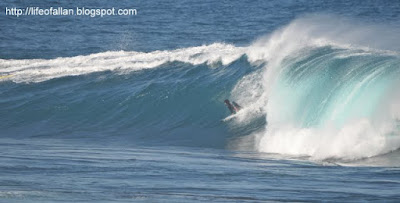
Excellent weather, some food heavy backpacks and time off - what more can you hope for? Out at Cape Vlamingh we were treated not only with the views of the Osprey family, but also with some hair raising performance by a couple of surfers in combo with helpers on two jet skis.


I have always though that it was cheating having a friend on a jet ski setting you up for the wave, but watching the battle against those waves at West End, I must admit that there was nothing looking like cheating there! Underwater reefs, massive surf and razor sharp rocks all along the coast - if it was me, I would have like a support vessel or two as well :-D